
The 14 Facial Bones: Complete Anatomy Guide
Most people don't think about their facial bones until an injury, medical condition, or diagnostic scan brings attention to them. While we often focus on the skin, muscles, and features that make up our appearance, the underlying facial skeleton provides the structure that supports everything from breathing and chewing to speaking and protecting important sensory organs.
Because the face contains multiple bones that work together in a complex framework, understanding facial anatomy can sometimes feel overwhelming. Parents researching a child's injury, patients recovering from facial trauma, or individuals preparing for oral and maxillofacial surgery often encounter unfamiliar medical terms and anatomical concepts that can be difficult to interpret without guidance.
The good news is that facial anatomy becomes much easier to understand when viewed as a system of interconnected bones, each with a specific purpose. These bones not only shape facial appearance but also support the eyes, nose, mouth, and jaw while helping perform essential everyday functions.
In this guide, we'll explore the 14 facial bones that make up the human face, explain how they differ from skull bones, discuss their functions, and review what happens when facial bones are fractured. We'll also cover treatment options, recovery expectations, and answer common questions about facial injuries and facial bone health.
What are facial bones?
Facial bones are the 14 bones that form the framework of the face. Together, they create the structure that supports the eyes, nose, mouth, cheeks, and jaws while helping perform essential functions such as breathing, eating, speaking, and facial expression.
Although the face appears to be a single unit from the outside, it is actually composed of several interconnected bones that work together to provide both strength and flexibility. These bones create the cavities that house important structures, including the eyes, nasal passages, teeth, and portions of the upper airway.
The facial skeleton also plays a significant role in appearance. The size, shape, and position of facial bones contribute to individual facial features and influence how the soft tissues of the face are supported.
The 14 facial bones include:
- 2 nasal bones
- 2 maxillae (upper jaw bones)
- 2 zygomatic bones (cheekbones)
- 2 lacrimal bones
- 2 palatine bones
- 2 inferior nasal conchae
- 1 vomer
- 1 mandible (lower jaw)
Some of these bones occur in pairs, while others exist as single structures located along the center of the face.
What is the difference between facial bones and skull bones?
Facial bones and skull bones are often discussed together because they form the skeleton of the head, but they serve different purposes.
Facial bones primarily support the structures of the face and help with functions such as:
- Chewing
- Speaking
- Breathing
- Swallowing
- Facial appearance
Skull bones, also called cranial bones, primarily protect the brain and form the protective casing around the cranial cavity.
The adult human skull contains 22 bones total:
- 8 cranial bones that surround and protect the brain
- 14 facial bones that form the facial skeleton
Examples of cranial bones include:
- Frontal bone
- Parietal bones
- Temporal bones
- Occipital bone
- Sphenoid bone
- Ethmoid bone
Examples of facial bones include:
- Maxillae
- Mandible
- Nasal bones
- Zygomatic bones
Although these groups have different functions, they work together as a unified structure. For example, the maxillae connect with several cranial bones, helping create the eye sockets, nasal cavity, and upper jaw.
Understanding the distinction is particularly important when discussing facial trauma. A facial fracture may involve only the facial bones, only the cranial bones, or both, depending on the location and severity of the injury.
If you live in Virginia Beach and experience facial trauma from any accident, oral and maxillofacial surgeons often work closely with other specialists to evaluate injuries involving both the facial skeleton and surrounding structures.
What bones make up the face?
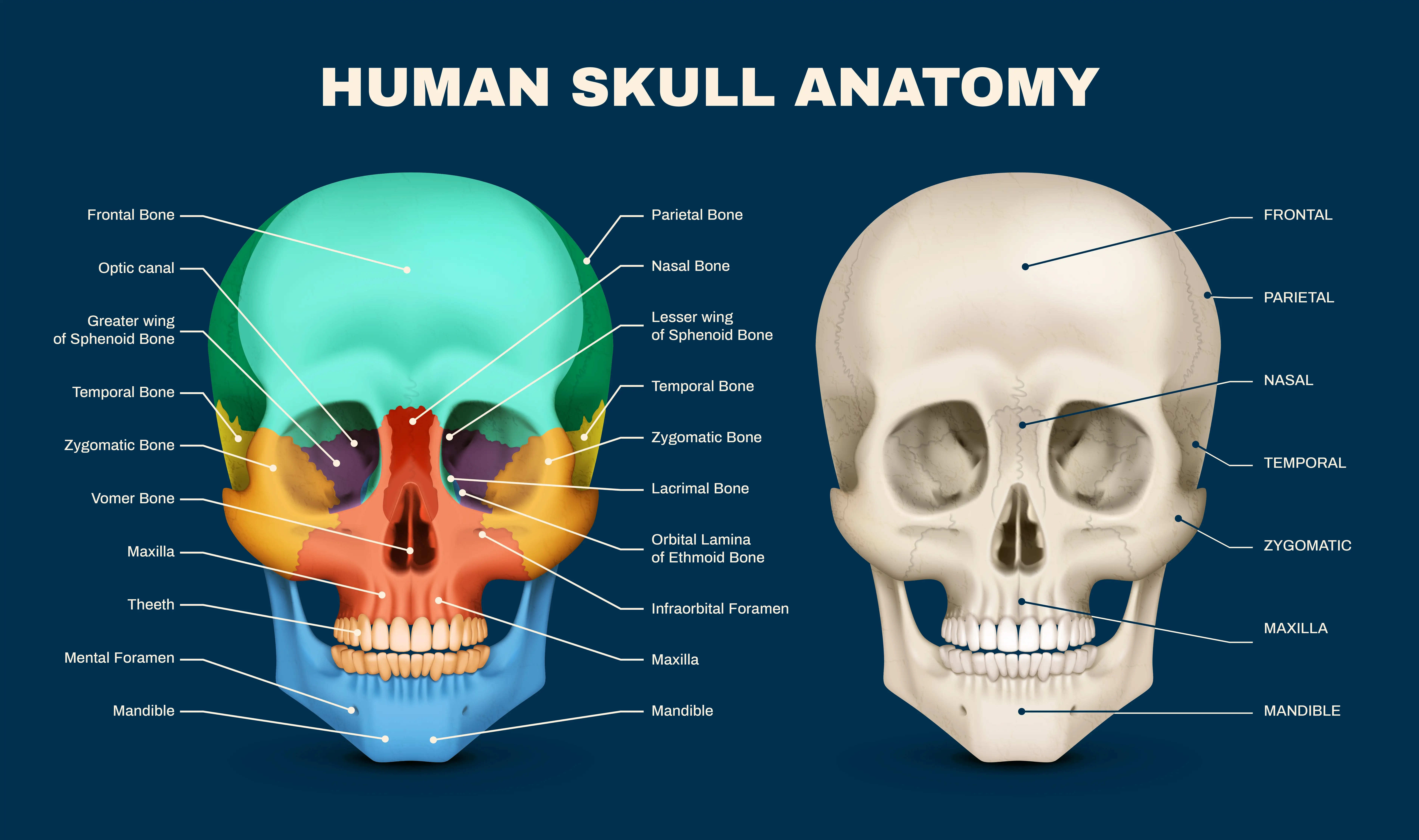
The facial skeleton consists of 14 individual bones that work together to support the eyes, nose, mouth, teeth, and jaws. These bones provide the framework that gives the face its shape while also protecting important structures and enabling functions such as breathing, chewing, swallowing, and speaking.
Although there are 14 facial bones, several occur in pairs on the right and left sides of the face. Understanding each bone helps illustrate how complex and interconnected facial anatomy truly is.
Right Maxilla and Left Maxilla (Upper Jaw Bones)
The maxillae are paired bones that form the upper jaw and much of the middle portion of the face.
Together, they help:
- Support the upper teeth
- Form part of the eye sockets
- Create portions of the nasal cavity
- To form the front portion of the hard palate
Because they connect with numerous surrounding bones, the maxillae serve as central structural components of the facial skeleton.
Mandible (Lower Jaw Bone)
The mandible is the only unpaired facial bone that can move.
As the largest and strongest facial bone, it forms the lower jaw and plays a critical role in:
- Chewing
- Speaking
- Swallowing
- Supporting the lower teeth
The mandible connects to the skull through the temporomandibular joints (TMJs), allowing movement of the jaw.
Right Zygomatic Bone and Left Zygomatic Bone (Cheekbones)
The zygomatic bones create the prominence of the cheeks and contribute to the outer walls of the eye sockets.
Their functions include:
- Supporting facial contour
- Protecting the eyes
- Helping distribute forces during facial impacts
Because of their prominent position, these bones are commonly involved in facial trauma.
Right Nasal Bone and Left Nasal Bone
The nasal bones form the bridge of the nose.
Although relatively small, they provide important structural support for:
- The upper portion of the nose
- The nasal airway
- Overall facial appearance
Nasal fractures are among the most common facial bone injuries.
Right Lacrimal Bone and Left Lacrimal Bone
The lacrimal bones are the smallest facial bones.
Located in the inner wall of each eye socket, they help form part of the tear drainage system.
Their primary roles include:
- Supporting the eye socket
- Housing portions of the nasolacrimal duct system
- Contributing to orbital anatomy
Right Palatine Bone and Left Palatine Bone
The palatine bones sit behind the maxillae and contribute to multiple facial structures.
These bones help form:
- The posterior portion of the hard palate
- The nasal cavity
- The floor of the eye sockets
They play an important role in separating the oral and nasal cavities.
Right Inferior Nasal Concha and Left Inferior Nasal Concha
The inferior nasal conchae are curved bones located along the side walls of the nasal cavity.
Their primary functions include:
- Warming inhaled air
- Humidifying inhaled air
- Improving airflow regulation through the nose
These structures help prepare air before it reaches the lungs.
Vomer
The vomer is a thin, unpaired bone located in the center of the nasal cavity.
It forms the lower portion of the nasal septum, which separates the left and right nasal passages.
The vomer helps:
- Support the internal structure of the nose
- Direct airflow
- Maintain normal nasal function
While less visible than other facial bones, it plays an important role in breathing and nasal anatomy.
Together, these 14 facial bones create a highly specialized framework that supports facial appearance, protects critical structures, and allows many of the essential functions people rely on every day.
What happens if a facial bone is fractured?

A facial bone fracture occurs when one or more of the bones that make up the facial skeleton break due to trauma. These injuries can range from minor cracks that heal with limited intervention to complex fractures that affect appearance, breathing, vision, or jaw function.
Common causes of facial bone fractures include:
- Falls
- Motor vehicle accidents
- Sports injuries
- Physical assaults
- Workplace accidents
The impact of a fracture depends on which bone is involved and how severe the injury is. For example, a nasal bone fracture may primarily affect the shape of the nose, while fractures involving the jaw, cheekbones, or eye sockets can interfere with essential functions such as chewing, speaking, and vision.
Because facial bones help protect important structures—including the eyes, airway, teeth, and brain—prompt evaluation is important whenever a facial injury is suspected.
How are facial bone fractures treated?
Treatment varies depending on the location, severity, and stability of the fracture.
Some fractures require only observation and supportive care, while others need surgical intervention to restore proper alignment and function.
Common treatment approaches include:
- Rest and activity restrictions
- Pain management
- Ice therapy to reduce swelling
- Soft-food diets for jaw injuries
- Antibiotics in certain situations
- Surgical repair using plates and screws
- Reconstruction of damaged facial structures
Oral and maxillofacial surgeons frequently treat fractures involving the jaw, cheekbones, upper jaw, and other facial structures.
The primary goals of treatment are to:
- Restore normal function
- Protect vision and airway structures
- Re-establish facial symmetry
- Promote proper healing
- Reduce the risk of long-term complications
If you live in Virginia Beach and experience facial trauma, early evaluation by a qualified oral and maxillofacial surgeon can help determine whether surgical treatment is necessary and improve the likelihood of a successful recovery.
What are the symptoms of a facial bone fracture?
Symptoms can vary depending on which bone is injured, but several warning signs commonly indicate a possible facial fracture.
These may include:
- Facial pain
- Swelling
- Bruising
- Facial asymmetry
- Numbness or tingling
- Difficulty opening or closing the mouth
- Problems chewing
- Nosebleeds
- Vision changes
- Double vision
- Loose or misaligned teeth
- A visible depression or deformity in the face
Some symptoms may not appear immediately after the injury. Swelling can sometimes mask the extent of the damage during the first few hours.
Any facial injury accompanied by difficulty breathing, vision changes, significant bleeding, or loss of consciousness should be treated as a medical emergency.
Can facial bones heal on their own?
Some facial bone fractures can heal without surgery, but not all fractures should be left untreated.
Small, stable fractures that remain properly aligned may heal naturally with close monitoring and supportive care. During healing, the body gradually forms new bone tissue that reconnects the fractured segments.
However, more severe fractures may require surgical treatment if they:
- Cause facial deformity
- Affect jaw function
- Impair vision
- Obstruct the airway
- Involve significant displacement of bone fragments
Attempting to "wait it out" without proper evaluation can increase the risk of long-term complications, including chronic pain, bite problems, breathing difficulties, and cosmetic concerns.
For this reason, any suspected facial fracture should be evaluated by a healthcare professional who can determine whether observation, medical management, or surgical repair is the most appropriate course of treatment.
What kind of doctor treats facial bone injuries?
The type of doctor who treats a facial bone injury depends on which bones and structures are affected. In many cases, multiple specialists work together to ensure proper healing and function.
Common specialists involved in facial trauma care include:
- Oral and Maxillofacial Surgeons – Specialists in diagnosing and treating injuries involving the jaw, cheekbones, eye sockets, and other facial bones. They often perform surgery when fractures need to be repaired or stabilized.
- Emergency Medicine Physicians – Typically, the first doctors to evaluate facial injuries after an accident, helping stabilize patients and coordinate specialist referrals.
- Otolaryngologists (ENT Specialists) – Treat injuries involving the nose, sinuses, and airway structures.
- Ophthalmologists – Evaluate and manage facial injuries that affect the eyes, vision, or eye sockets.
- Plastic and Reconstructive Surgeons – May assist with complex facial injuries that require reconstruction of facial structures or soft tissues.
Because facial bones support critical functions such as breathing, chewing, speaking, and vision, prompt evaluation is important after any significant facial injury. If you live in Virginia Beach and experience facial trauma, an oral and maxillofacial surgeon is often a key member of the treatment team responsible for restoring both function and appearance.
FAQs
Can facial bones change over time?
Yes. Facial bones naturally change throughout life. During childhood and adolescence, they grow and develop as the face matures. In adulthood, gradual changes can occur due to aging, tooth loss, hormonal influences, and bone density changes. These shifts can affect facial contours and overall appearance over time.
How long does it take for facial bones to heal?
Most facial bone fractures heal within 6 to 8 weeks, although recovery time varies depending on the location and severity of the injury. More complex fractures or injuries requiring surgery may take several months to fully heal.
Can facial bones be reconstructed after injury?
Yes. Modern reconstructive techniques allow surgeons to repair and rebuild many facial bones after trauma. Depending on the injury, treatment may involve plates, screws, bone grafts, or other specialized surgical techniques designed to restore both appearance and function.
Are facial bone injuries serious?
They can be. Some facial fractures are relatively minor, while others may affect vision, breathing, chewing, or jaw movement. Because facial bones protect important structures such as the eyes, airway, and teeth, any significant facial injury should be evaluated by a medical professional.
Can facial bones affect breathing or chewing?
Absolutely. Facial bones help form the nasal passages, jaws, and oral cavity. Injuries or abnormalities involving these bones can sometimes lead to breathing difficulties, bite problems, chewing challenges, or impaired jaw function.
What imaging tests are used to evaluate facial bones?
Doctors commonly use imaging studies to assess facial bone injuries and abnormalities. These may include:
- X-rays
- Computed tomography (CT) scans
- Cone beam CT (CBCT) scans
- Magnetic resonance imaging (MRI) in certain situations involving soft tissues
CT scans are often considered the gold standard for evaluating facial fractures because they provide highly detailed images of the facial skeleton.
Are facial bones different in children and adults?
Yes. Children's facial bones are still growing and contain developing structures that are not fully mature. Because of this, facial injuries in children may behave differently than those in adults and often require specialized evaluation that takes future growth into account.
How can facial bone injuries be prevented?
While not all accidents can be avoided, several measures can help reduce the risk of facial trauma:
- Wearing seat belts
- Using appropriate sports protective equipment
- Wearing helmets during recreational activities
- Following workplace safety guidelines
- Using fall-prevention measures when appropriate
Taking these precautions can significantly lower the likelihood of facial injuries and help protect both facial function and appearance.
Can You Better Understand Facial Injuries and Conditions Now?
Facial bones do much more than shape a person's appearance. They provide the structural framework for the face, protect important organs, support breathing and chewing, and play a critical role in speech, vision, and overall facial function.
In this guide, we explored the 14 facial bones that make up the facial skeleton, including their locations, anatomy, and individual functions. We also discussed the differences between facial bones and cranial bones, how facial fractures occur, common symptoms of facial injuries, and the treatment options available when damage affects the facial skeleton.
Understanding facial anatomy is especially important when injuries occur. Because facial bones are closely connected to the eyes, nose, teeth, jaws, and airway, even seemingly minor trauma can sometimes lead to complications that require specialized care. Early evaluation and appropriate treatment can help restore function, support proper healing, and reduce the risk of long-term issues.
Some facial injuries and conditions may also require bone grafting procedures to rebuild lost bone, restore facial structure, or prepare for future treatment. Learn more about how bone grafting can support oral and facial health!
Whether you're researching facial anatomy, recovering from an injury, or preparing for treatment, having a better understanding of the facial skeleton can help you make more informed decisions about your health and care options.
